If you're searching for an OpenClaw alternative, you're probably not looking for another flashy demo. You're looking for something that solves the same core problem, which is getting real work off your plate, without turning you into part-time IT support. That usually means one of three frustrations: setup is heavier than expected, ongoing maintenance keeps eating time, or the tasks you actually care about still involve the real world, especially phone calls, hold times, and business hours.
This guide walks through the strongest replacements for OpenClaw in 2026, who each one is best for, and how to choose based on the work you actually need done.
Why People Start Looking for an OpenClaw Alternative
Most people do not search for an alternative because they hate the original product. They search because reality gets in the way.
With OpenClaw, the appeal is obvious: open source, flexible, chat-based control, memory, skills, and a fast-moving community. For developers and technical tinkerers, that is exciting. You can build a very customized AI assistant around your own workflows.
But the tradeoff is that flexibility comes with responsibility.
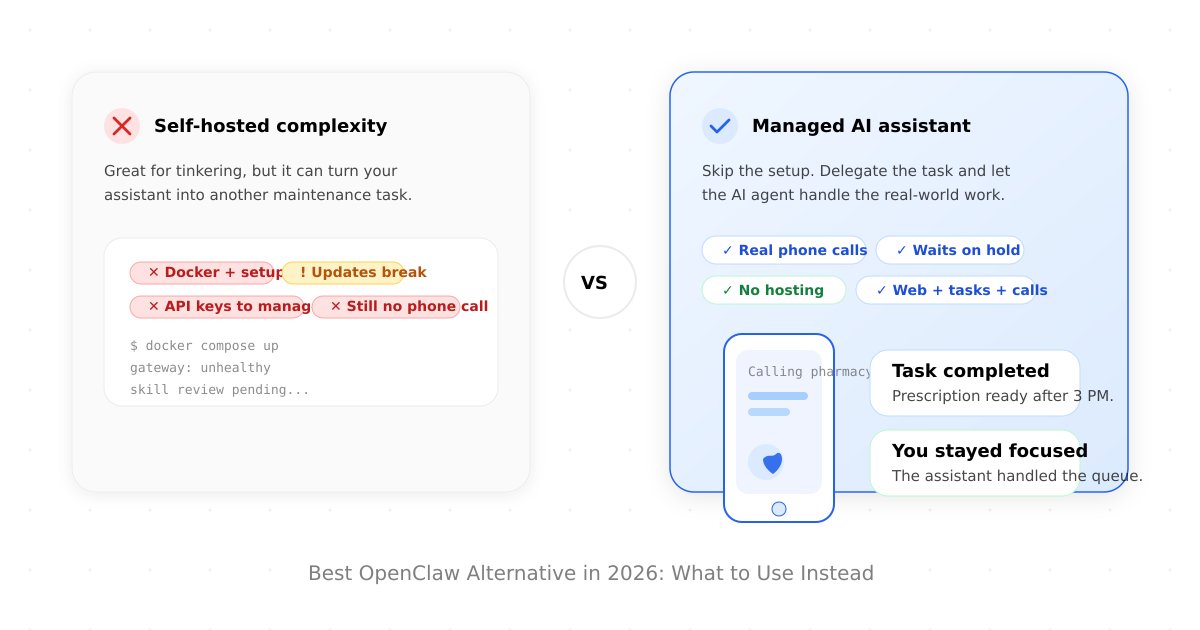
A typical OpenClaw user may need to:
- run and maintain a machine that stays online
- manage model providers and API keys
- troubleshoot gateway or integration issues
- evaluate third-party skills carefully
- handle updates, version drift, and occasional breakage
What to Look for in an OpenClaw Alternative
Before comparing tools, define what "better" means for you. The best replacement for OpenClaw for a solo developer is not the same as the best option for a busy parent or small business owner.
Here are the criteria that matter most.
1. Setup burden
How long does it take to go from account creation to useful output? If a tool needs Docker, terminal comfort, and several integrations before it is useful, that is a real cost.
2. Real-world action
Can the AI agent do more than generate text? Can it call a doctor's office, navigate an IVR menu, wait on hold, screen incoming calls, or handle phone-based tasks that still dominate everyday admin work?
3. Reliability
Does the product work consistently enough to trust with recurring tasks? An AI assistant that is brilliant 80 percent of the time but fails when you need it most can create more work than it removes.
4. Privacy and control
Some users want local-first tools and maximum control. Others are happy with a hosted system if it saves them time. There is no universal right answer here, only fit.
5. Cost structure
A free or open-source tool is not truly cheap if it consumes hours of setup and maintenance. Likewise, a paid tool is not expensive if it saves five hours a month.
Best OpenClaw Alternative Options in 2026
There is no single winner for every person, so it helps to separate these tools by job to be done.
1. Assindo
Best for: people who want an AI agent that handles phone calls and real-world admin with no setup
Assindo is the strongest fit for people whose biggest bottlenecks are not code or browser automation, but all the annoying tasks that still require a phone.
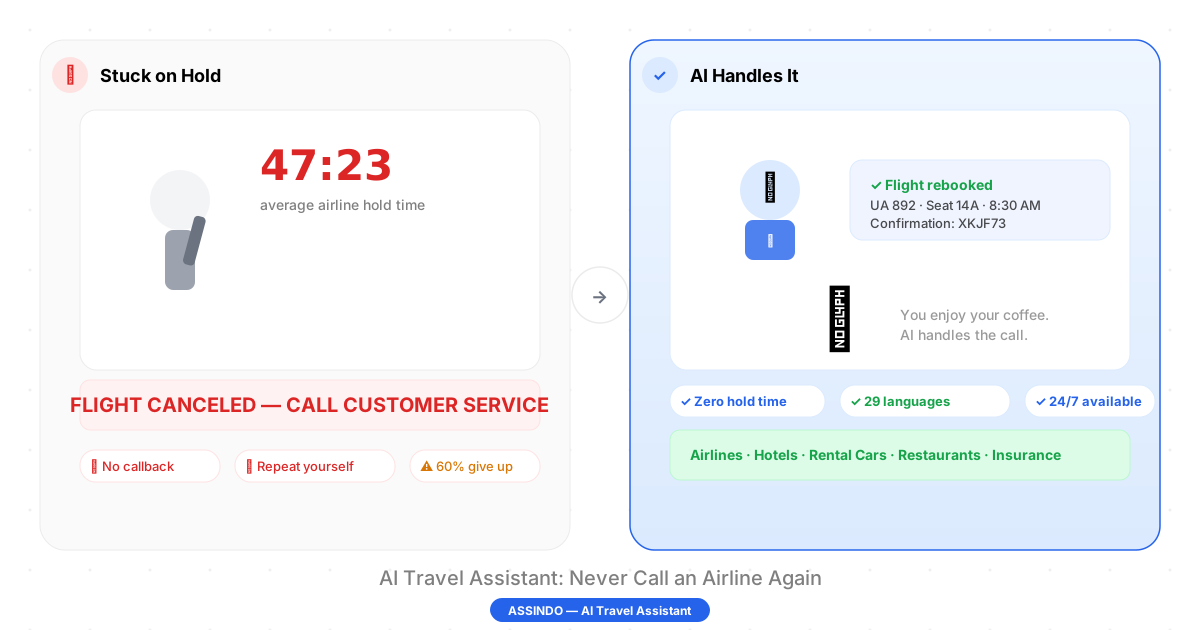
That is the key difference. Most AI assistants stay inside a browser, chat window, or terminal. Assindo crosses into the real world. It can make actual phone calls, navigate IVR menus, wait on hold, screen incoming calls, search the web, schedule tasks, and handle follow-up work from one place.
For a busy professional, that means asking an AI agent to call the pharmacy, confirm whether a prescription is ready, and report back. For a parent, it means calling the pediatrician's office right when the line opens. For a small business owner, it means checking a supplier ETA without burning twenty minutes listening to hold music.
You also do not need to self-host anything. There is no hardware to keep online, no Docker setup, and no API key juggling. That changes the economics a lot. If your goal is delegation rather than experimentation, a managed AI assistant often beats a customizable one.
Where Assindo is better than OpenClaw:
- handles real phone calls, not just digital workflows
- no self-hosting or infrastructure setup
- better fit for non-technical users
- easier to treat like a real assistant instead of a project
Where OpenClaw is better:
- more flexible for deeply custom, developer-driven workflows
- stronger fit for users who want full control of their stack
- more appealing if open source is a hard requirement
Bottom line: If you want something useful right now, especially for phone-heavy life admin, Assindo is the most practical option. Plans start at $70/month.
2. ChatGPT
Best for: research, writing, brainstorming, document work
ChatGPT remains one of the best pure AI assistant products on the market. It is excellent for drafting, summarizing, coding help, planning, spreadsheet analysis, and answering questions quickly.
As a replacement option, though, it fills a different role. It can help you think and prepare. It usually cannot complete the full real-world workflow on your behalf, especially when that workflow requires calling a person or staying on hold.
A good example is billing support. ChatGPT can help you draft what to say to your cable company, list negotiation points, and even role-play the conversation. But if you need someone to actually sit on hold for forty minutes and talk to retention, you still need another layer.
Best if you want: an elite digital AI assistant, not necessarily an autonomous real-world operator.
3. Google Gemini
Best for: Google ecosystem users who live in Docs, Gmail, and Workspace
Gemini is a strong option for people whose work already runs through Google. It is especially useful for email drafting, document summarization, search-heavy tasks, and workflow support inside Google's ecosystem.
Like ChatGPT, Gemini is more of an intelligence layer than a complete OpenClaw replacement for action-heavy work. It helps with preparation, synthesis, and lightweight execution. It is less compelling if your pain points involve customer service calls, scheduling by phone, or juggling tasks that happen outside the browser.
Best if you want: deep Google integration and a polished general AI assistant.
4. Human virtual assistant services like Fancy Hands or BELAY
Best for: users who prefer a human in the loop
This category matters because some people comparing replacements are really searching for relief, not software.
Fancy Hands is built around quick delegated tasks. BELAY is more of a premium, ongoing support model. Both appeal to users who would rather have a human assistant handle messy edge cases, relationship-sensitive communication, or tasks that benefit from judgment and nuance.
The downsides are cost, speed, and scalability. Human virtual assistant services can be excellent, but they do not have the same instant availability or asynchronous automation benefits as a good AI agent. They also tend to become much more expensive as task volume grows.
A practical example: if you need a recurring weekly call to reschedule appointments, check supplier inventory, and screen unknown callers, an AI assistant can often do that faster and more cheaply. If you need someone to coordinate a complex executive calendar with multiple stakeholders and subtle preferences, a human may still win.
Best if you want: human judgment more than software speed.
5. DIY stack using ChatGPT, Zapier, and voice tools
Best for: builders who want a custom workflow without going all-in on OpenClaw
Some users do not actually need a full agent platform. They need a stack. For example:
- ChatGPT or Gemini for reasoning
- Zapier or Make for automation
- a telephony layer for calls
- calendar and email integrations for execution
This can work if your use case is narrow and you like stitching tools together. The upside is modularity. The downside is obvious: you become the integration layer.
Best if you want: maximum customization and do not mind assembling the system yourself.
OpenClaw Alternative Comparison by Use Case
The easiest way to choose is to match the tool to the actual task.
If you want an AI assistant for phone calls
Pick Assindo.
This is the clearest gap in the market. Most AI assistants can tell you how to solve a problem. Very few can call and solve it for you. If you regularly deal with appointment scheduling, insurance questions, pharmacy follow-ups, gym cancellations, school attendance lines, or business vendor calls, phone capability matters more than model cleverness.
If you want an AI agent for coding and experimentation
OpenClaw may still be the better fit, or a DIY stack might be.
If your real joy is building custom skills, testing new workflows, and controlling the environment, switching away may not actually help. In that case, you may just want better documentation and a cleaner setup.
If you want a general-purpose productivity assistant
Pick ChatGPT or Gemini if your work is mostly digital.
For writing, note-taking, research, summaries, and inbox support, both are excellent. They are the right answer for a lot of people, just not for tasks that still involve the phone system.
If you want a delegated helper with human judgment
Pick Fancy Hands, BELAY, or another human virtual assistant service.
This is often the right choice for high-context work, executive support, or relationship-driven communication where a polished human touch matters more than speed.
The Big Decision: Customization or Delegation?
This is the real fork in the road.
OpenClaw is attractive because it invites customization. It feels powerful because it is flexible, local, and extensible. But the more customizable a tool is, the more likely you are to spend time operating it.
The best option for many people is the product that removes that burden completely.
If you are a founder, parent, operator, consultant, or small business owner, ask a blunt question: do you want to build an assistant, or do you want to have one?
Those are different goals.
If you want to build one, OpenClaw or a modular DIY stack makes sense. If you want to have one, the balance shifts toward managed tools like Assindo or, in some cases, a human VA service.
Which OpenClaw Alternative Is Best?
For most non-technical users, the best choice is the one that delivers outcomes with the fewest moving parts.
If you want the broadest real-world action, especially around calls, hold times, IVR navigation, and delegated admin, Assindo is the strongest option today. If you want a digital brain for writing and research, ChatGPT or Gemini may be enough. If you want a real person handling nuanced work, a human virtual assistant service still has a place.
The mistake is assuming these tools are interchangeable. They are not. An AI agent, an AI assistant, and a human VA may all reduce workload, but they do it in very different ways.
So choose based on the task that wastes the most time in your week.
If that task starts with, "I need to call...," the answer is unusually clear.
Skip the setup and let your AI assistant handle the call
If you want an AI assistant that can actually call, wait on hold, and get the answer for you, Assindo is built for that job.