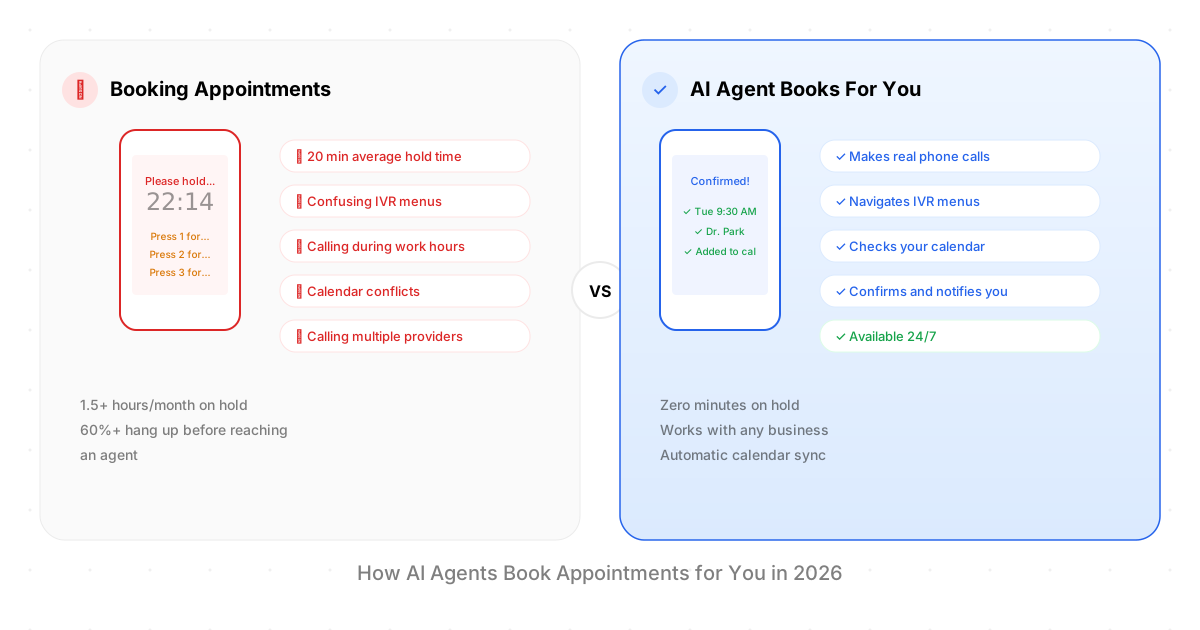
You know the drill. You need a dentist appointment, a haircut, or a table at that restaurant that never picks up. So you call. You wait through a recorded menu, press 3 for scheduling, sit on hold for twelve minutes, and then get told "our next availability is Thursday at 2:15." Thursday does not work. You say so. They check again. "How about the following Monday at 11?" You pull up your calendar. It works. You confirm. Twenty-two minutes for one appointment.
Now multiply that by the four or five appointments the average person books every month. Doctor visits, car service, parent-teacher conferences, gym orientations, vet checkups. That is over an hour and a half each month just navigating phone trees and waiting on hold.
This is exactly the kind of repetitive, time-consuming task that AI agents were built to handle. In this guide, you will learn how an AI agent can book appointments for you, what the technology can and cannot do today, and which tools actually deliver on the promise.
What Does It Mean for an AI Agent to Book an Appointment?
When people hear "AI scheduling," they usually think of calendar apps. Tools like Calendly or Google Assistant can find open slots and send meeting links. That is scheduling, and it works well for meetings between people who both use the same digital system.
But most real-world appointments do not work that way. Your dentist does not have a booking link. Your mechanic answers the phone or he does not. The salon receptionist writes names in a paper book. These appointments require an actual phone call, a human conversation, and real-time negotiation of available times.
An AI agent that can book appointments needs to do three things:
1. Make a real phone call to the business 2. Navigate whatever system picks up - a person, an IVR menu, voicemail 3. Negotiate a time that fits your calendar, confirm it, and report back to you
This is agentic AI. Not a chatbot that gives you a link, but an AI assistant that acts on your behalf in the real world.
Why Appointment Booking Is Harder Than It Sounds
If you have ever asked Siri to book a restaurant, you already know the problem. Digital assistants are great at setting timers and sending texts, but they hit a wall the moment they need to interact with a human or a phone system.
Here is why appointment booking by AI is genuinely difficult:
Unpredictable phone systems. Some businesses have modern phone trees. Others have a receptionist who answers with "hello?" and expects you to state your business. Some put you through a five-minute IVR gauntlet before you reach a human. An AI agent needs to handle all of these.
Natural language negotiation. Finding a time that works is a back-and-forth conversation. The business says "we have Tuesday at 3 or Thursday at 10." Your AI agent needs to check your calendar, evaluate the options, pick one, and confirm. That requires understanding context, not just following a script.
Varied business types. A doctor's office asks for your date of birth and insurance info. A restaurant wants to know how many people. A mechanic asks about your car's make and model. Each appointment type needs different information, and the AI agent needs to collect it from you beforehand.
No-show policies and deposits. Some businesses require a credit card to hold a reservation. Others have cancellation windows. Your AI agent needs to understand these constraints and either handle them or flag them for you.
Until recently, no AI assistant could do all of this. The phone call itself was the bottleneck. Large language models are great at conversation, but they do not have phone lines. That has changed.
How the Process Works with an AI Agent
Let us walk through a real example. Say you need to book a dentist appointment.
Step 1: You tell the AI agent what you need. You say something like "Book a cleaning with Dr. Park's office. I prefer mornings, any day next week except Wednesday."
Step 2: The AI agent calls the office. It dials the number, waits for an answer, and handles whatever picks up. If it is a receptionist, it introduces itself and explains that it is calling on your behalf. If it is an IVR menu, it navigates the options to reach scheduling.
Step 3: The conversation happens. The AI agent and the receptionist discuss available times. Your agent checks your calendar and finds a match. It confirms the appointment, provides your name and any required details, and hangs up.
Step 4: You get a notification. Your AI agent sends you a summary: "Your cleaning with Dr. Park is confirmed for Tuesday, April 28 at 9:30 AM. Bring your insurance card." The appointment is added to your calendar automatically.
The entire process takes the AI agent a few minutes. You spent zero minutes on the phone.
Real-World Scenarios Where AI Appointment Booking Shines
Here are five common situations where having an AI agent book appointments saves significant time and frustration.
Medical and dental appointments. Doctor offices are notorious for long hold times and complex phone menus. A study by the Journal of the American Medical Association found that the average time to schedule a primary care appointment by phone is over eight minutes, with some reaching twenty minutes. An AI agent handles the wait so you do not have to.
Restaurant reservations. Popular restaurants often do not use online booking systems, or their OpenTable slots are always taken while the phone line has cancellations available. An AI agent can call at the right time, speak to the host, and grab a table that was never listed online.
Car maintenance and service. Auto shops rarely have online schedulers. You call, describe the issue, and the service writer tells you when to bring it in. An AI agent can explain the problem, get a time estimate, and book the drop-off without you spending fifteen minutes on a crackly speakerphone in the waiting room.
Home services. Plumbers, electricians, HVAC technicians, house cleaners. These businesses run on phone calls. An AI agent can call multiple providers to compare availability and pricing, then book the best option. What would take you an hour of calling around takes the AI agent ten minutes.
School and childcare. Parent-teacher conferences, enrollment appointments, tour bookings for daycares. These often happen during business hours when parents are at work. An AI agent handles the call while you focus on your job.
AI Agents vs Traditional Scheduling Tools
You might be wondering how an AI agent compares to the scheduling tools you already use. Here is a breakdown.
Calendar apps (Google Calendar, Apple Calendar): Great for blocking time and sharing availability. Cannot make phone calls or interact with businesses.
Booking platforms (Calendly, Acuity, OpenTable): Excellent when the business uses them. Useless when they do not. Most small businesses and medical offices do not.
Virtual assistants (Siri, Google Assistant, Alexa): Can set reminders and send calendar invites. Cannot make phone calls to businesses, navigate IVR menus, or have real-time scheduling conversations.
Human virtual assistants (Fancy Hands, Belay, Time Etc): Can absolutely book appointments by phone. But they cost significantly more, have turnaround times of hours to a day, and you are limited by their working hours. A human VA service typically charges $25-50 per hour or several hundred dollars per month.
AI phone agents (Assindo): Make real phone calls, navigate menus, negotiate times, and confirm appointments. Available 24/7, work in minutes, and cost a fraction of human VA services. The tradeoff is that they may struggle with highly unusual or complex scheduling situations where human judgment is critical.
What to Look for in an AI Appointment Booking Agent
If you are evaluating AI agents for appointment booking, here are the features that matter most.
Real phone call capability. This is non-negotiable. If the AI agent cannot make an actual outbound phone call, it cannot book most real-world appointments. Ask specifically whether the tool calls businesses on your behalf or just manages your calendar.
Calendar integration. The AI agent needs to read your existing calendar to find available times and write new appointments back to it. Without this, you are still managing the scheduling manually.
Natural conversation handling. The agent should be able to handle varied phone interactions, from simple "yes, we have an opening" exchanges to more complex negotiations with multiple time options.
Information collection. Before the call, the agent should ask you for any details the business will need: your name, date of birth, insurance info, party size, vehicle details, or anything else relevant to the appointment type.
Confirmation and follow-up. After booking, the agent should send you a clear summary with the date, time, location, and any instructions. Ideally it adds the event to your calendar automatically.
Getting Started with AI Appointment Booking
The easiest way to start booking appointments with an AI agent is Assindo. It is available on iOS, Android, and the web, and it can make real phone calls to businesses on your behalf.
Here is how to set it up:
1. Download the app and create an account 2. Connect your calendar so the AI agent knows your availability 3. Tell it what appointment you need: "Book a haircut at SuperCuts, any evening this week" 4. The AI agent makes the call, negotiates the time, and confirms the booking 5. You get a notification with all the details
There is no setup beyond connecting your calendar. The AI agent handles the entire phone interaction from dialing to confirmation.
The Bigger Picture: AI Agents and the Phone Call Problem
Appointment booking is one piece of a larger shift. AI agents are moving from digital-only tasks (summarizing emails, writing code, generating images) to real-world actions (making phone calls, navigating physical systems, completing transactions).
The phone call is the frontier. Businesses run on phone calls. Government offices, medical providers, restaurants, service companies, schools. An AI agent that cannot make calls is limited to the digital layer of life. An AI agent that can call, wait on hold, navigate menus, and have natural conversations opens up the other eighty percent of daily tasks that still require picking up the phone.
We are still early. AI agents are not perfect. They can misunderstand a heavily accented receptionist or get stuck in a poorly designed IVR loop. But the technology is improving fast, and for routine appointment booking, it already works well enough to save you meaningful time every week.
The question is not whether AI agents will handle your appointments. It is whether you want to be the person still spending twenty minutes on hold or the person whose AI agent already confirmed the booking while you were making coffee.
Stop Spending Your Lunch Break on Hold
Let an AI agent book your appointments by making real phone calls for you. No more waiting through menus, no more interrupted workdays.